Architecture
SkillWeave executes a pipeline of skills that read and write a shared, typed STATE object. The orchestrator drives execution, the three frozen base skills provide transport / assertion / logging, and a boundary judge validates probabilistic output.
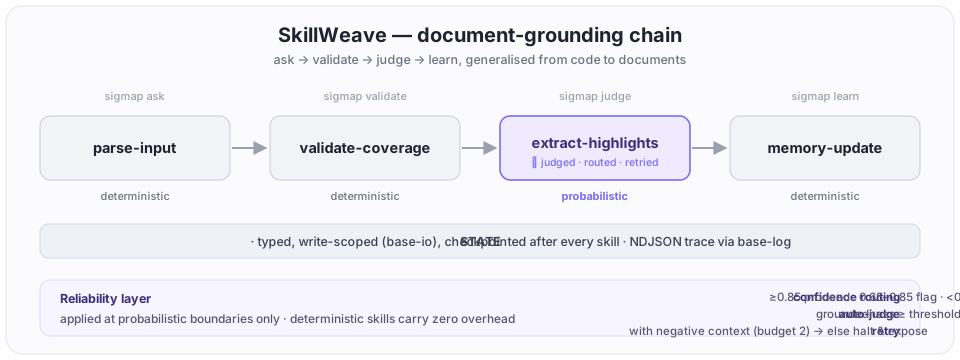
The chain
parse-input  →  validate-coverage  →  extract-highlights  →  memory-update
(sigmap ask)    (sigmap validate)     (probabilistic)         (sigmap learn)
                                      ↑ auto-judged · confidence-routed · retried
This maps SigMap's production ask → validate → judge → learn workflow onto the document domain — the same pattern, a different domain.
Components
| File | Role |
|---|---|
src/orchestrator.ts | Drives the pipeline; owns confidence routing, auto-judge, and retry |
src/types.ts | The primitive types: SKILL, PIPELINE, STATE, ASSERTION + reliability types |
src/judge.ts | Multi-LLM boundary judge + offline heuristic fallback |
src/base/base-io.ts | (frozen) STATE writes (scope-enforced) + checkpoints |
src/base/base-assert.ts | (frozen) runs declared assertions; failure halts |
src/base/base-log.ts | (frozen) NDJSON trace + execution summary |
src/skills/*.ts | The four domain skills of the reference chain |
STATE
STATE is a single typed object threaded between skills. Each field is written only by its owning skill, and base-io enforces the write scope — a skill that writes a field it didn't declare in state_write throws. The framework-managed _meta block carries the pipeline name, run id, and checkpoint list.
After every skill, base-io writes an immutable STATE checkpoint to traces/checkpoints/, giving you a step-by-step snapshot of execution.
Execution loop
For each skill the orchestrator:
- runs the skill (passing negative context on a retry);
- applies its declared STATE writes via
base-ioand checkpoints; - for probabilistic skills only — routes on confidence, runs the boundary judge, and retries with negative context on failure (see Reliability);
- runs the skill's assertions via
base-assert; - records a trace row via
base-log.
Deterministic skills skip step 3 entirely — zero reliability overhead.
Observability
base-log writes one NDJSON line per attempt to traces/<run-id>.ndjson, in a format compatible with SigMap's usage.ndjson:
{"ts":"…","pipeline":"document-grounding","skill":"extract-highlights","class":"probabilistic","duration_ms":1,"cost":0,"judge_score":1,"confidence":0.9,"confidence_band":"high","attempt":1,"status":"success","summary":"selected 3 highlights"}The execution summary is always printed; on failure it auto-exposes full diagnostics (which skill, which assertion, the judge score, cost so far). Everything is local — zero telemetry.
Design principles
- Base skills are frozen — no domain logic ever enters
base-io/base-assert/base-log. - Composition over inheritance — skills declare what they use, not what they extend.
- Classify before mitigating — deterministic skills get no judge, routing, or retry.
- Transparency on failure — the failure path is never silent.